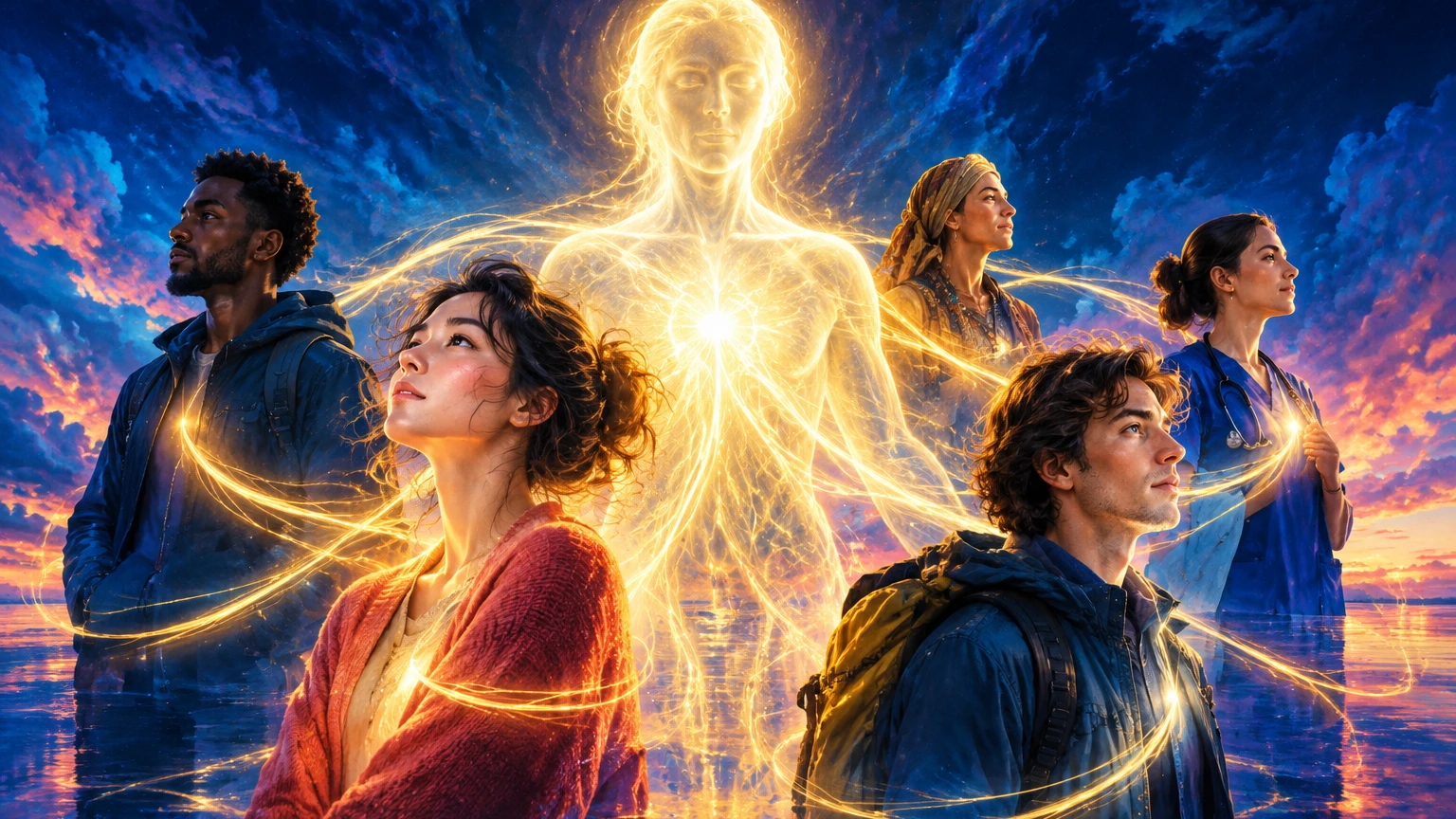
Open Individualism as the Foundation of the Ethics of the Future
After listening to the opera "2084 — One Hundred Years After Childhood" by the band Complex Numbers https://complexnumbers.ru/2084/, which describes a future society, I realized that the only adequate worldview and foundation for the ethics of the future should be not some scientific or religious conception, but the philosophical conception of "Open Individualism". The term itself was introduced by American philosopher Daniel Kolak in his 2004 book "I Am You," although the idea itself appeared in the works of Tsiolkovsky, Schopenhauer, Schrödinger, Dyson, and other authors.
Open individualism (OI) is a philosophical conception according to which "there is one self shared by everyone"—all people are one and the same single subject. Kolak distinguishes the self as a single noumenal self (real, but accessible only to the mind), which manifests as a multitude of phenomenal selves (that is, those given to us in sensory experience). It is like one actor appearing in many roles, rather than a collective consciousness. The noumenal self has no boundaries, is not born, and does not die.
The everyday position—that of "closed individualism," according to which each of us is a separate person with clear boundaries—is inconsistent and contradictory. Even the conception of empty individualism (there are no persons at all) is more consistent, but it rejects the very notion of personhood and devalues life.
What Boundaries Can There Be Between People?
We cannot, through an effort of will, "stop seeing" boundaries between people, just as we cannot stop seeing the sunset. To overcome this, we need to understand that the boundaries between phenomenological selves are not insurmountable barriers for the noumenal self.
Therefore, to regard open individualism as the best philosophical conception of personhood, we need to examine the blurred conceptual boundaries between people:
- boundaries of subject identification: in a dream, nothing prevents all the characters from being conscious and, at the same time, being only you.
- physiological boundaries: separating the hemispheres of one person's brain divides consciousness into two streams, which means that you, too, may be a stream of a single consciousness running in parallel with all other people.
- spatial boundaries: in cloning or teleportation (as in the film "The Prestige"), we can equally regard two clones as the same person or as two different people.
- psychological boundaries: in multiple personality disorder (as in the novel "The Minds of Billy Milligan"), one subject can have many personalities.
- metaphysical boundaries: a person, understood as an immaterial soul, cannot be individuated.
- moral boundaries: if other people are the same subject, then the opposition between "egoism and altruism" disappears
- Open individualism does not deny the existence of physical boundaries between people; it denies their ability to divide a single subject.
A Metaphysical Foundation for Global Ethics
The new ethics based on open individualism has the following central argument: to harm others is to harm yourself. This is not morally wrong, but pathological and irrational, because you will experience that suffering. To help others is to help yourself. The true cause of evil and anomie (lawlessness) is the failure to understand that we are harming ourselves. This argument also provides a metaphysical foundation for utilitarianism —an ethical theory according to which the moral value of an action is determined by its utility and its ability to bring the greatest happiness to the greatest number of people. Thus, maximizing overall happiness and minimizing pain become a matter of purely rational calculation. It is also very useful to build not merely a safe society, but a society with maximum freedom and diversity, so that the experience of each phenomenal self is as rich as possible.
What Open Individualism Can Be Compared To
Essentially, closed individualism can be compared to the illusion of the Sun revolving around the Earth: we can overcome this illusion through reason and place at the center of the world not the Earth, or even the Sun, but the single subject, which leads us to open individualism. Open individualism, in turn, can be compared to a special form of capitalism rather than communism, since it is essentially a game of chess against ourselves, implying rational competition among all your selves to maximize the common good (your own).